Delving into Understanding Different Levels of AI: From Narrow to Superintelligence, this introduction immerses readers in a unique and compelling narrative, with a casual formal language style that is both engaging and thought-provoking from the very first sentence.
In the following paragraphs, we will explore the intricacies of different levels of AI, from narrow to superintelligence, and how each level impacts various aspects of our lives.
Different Levels of AI
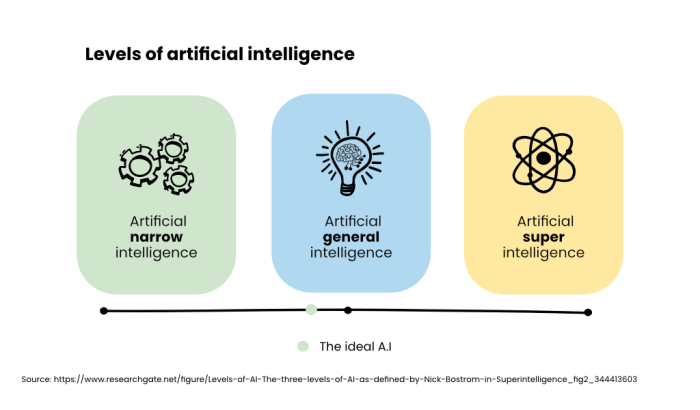
Artificial Intelligence (AI) can be categorized into different levels based on their capabilities and functionalities. These levels range from narrow AI to superintelligence, each with distinct characteristics and applications.
Narrow AI
Narrow AI, also known as weak AI, refers to AI systems that are designed to perform specific tasks or solve particular problems. These systems are focused on a narrow range of activities and lack the ability to generalize beyond their predefined functions.
Examples of narrow AI include virtual assistants like Siri and Alexa, chatbots, and recommendation algorithms used by streaming platforms.
General AI
General AI, also known as strong AI or human-level AI, is the concept of AI systems that possess the ability to understand, learn, and apply knowledge across a wide range of tasks similar to human intelligence. These systems have the capacity to adapt to new situations, learn from experience, and demonstrate reasoning abilities.
General AI aims to replicate human cognitive functions and perform tasks that require human-like intelligence.
Artificial Superintelligence
Artificial superintelligence refers to AI systems that surpass human intelligence in all aspects, including cognitive abilities, problem-solving skills, creativity, and emotional intelligence. These systems have the potential to outperform humans in every domain and may exhibit superhuman capabilities. Artificial superintelligence remains a theoretical concept, but its development raises ethical and existential concerns about the implications of creating machines with intelligence far superior to our own.
Applications of AI
AI is already being utilized in various industries and fields, ranging from narrow AI applications to the potential of superintelligence in the future. Let's explore some examples of how AI is being applied today and how it might impact industries in the future.
Narrow AI Examples
- Virtual Personal Assistants like Siri and Alexa are examples of narrow AI that help users with tasks like setting reminders, answering questions, and providing recommendations.
- Recommendation systems used by streaming services like Netflix and Spotify analyze user data to suggest personalized content based on viewing or listening habits.
- Fraud detection algorithms in banking and finance use AI to detect unusual patterns and flag potentially fraudulent transactions in real-time.
General AI Impact on Industries
- In healthcare, general AI could assist in diagnosing diseases more accurately and quickly, leading to improved patient outcomes and personalized treatment plans.
- In manufacturing, general AI could optimize production processes, predict maintenance needs, and increase efficiency on the factory floor.
- In transportation, general AI could enhance autonomous vehicle technology, leading to safer and more efficient modes of transportation.
Potential Applications of Artificial Superintelligence
- Advanced scientific research: Superintelligent AI could accelerate scientific discoveries by analyzing vast amounts of data and simulations to uncover complex patterns and solutions.
- Climate change mitigation: Superintelligence could help develop innovative solutions to combat climate change, optimize energy usage, and reduce environmental impact.
- Space exploration: Superintelligent AI could assist in exploring the cosmos, analyzing data from telescopes and spacecraft to uncover new insights about the universe.
Development of AI Systems
The process of creating AI systems involves various levels of complexity and challenges, depending on the type of AI being developed.
Creating Narrow AI Algorithms
Narrow AI algorithms are designed to perform specific tasks or solve particular problems within a limited domain. The development of narrow AI involves:
- Gathering and preprocessing data relevant to the specific task
- Choosing the appropriate machine learning algorithms for training the model
- Training the model using labeled data to make predictions or decisions
- Evaluating and fine-tuning the model based on performance metrics
Comparing General AI and Narrow AI Development
Developing general AI, also known as artificial general intelligence (AGI), is significantly more complex than creating narrow AI. General AI aims to exhibit human-like intelligence and cognitive abilities across a wide range of tasks and domains. The challenges in developing general AI include:
- Building a system capable of learning and adapting to new tasks without reprogramming
- Addressing ethical concerns and ensuring the safe and responsible use of AGI
- Understanding and replicating complex human cognitive processes
- Creating systems with self-awareness, consciousness, and emotional intelligence
Designing Artificial Superintelligence
Artificial superintelligence refers to AI systems that surpass human intelligence in all cognitive tasks. The challenges in designing and implementing artificial superintelligence include:
- Ensuring control and alignment with human values and goals
- Managing the potential risks associated with superintelligent systems
- Addressing concerns about the impact of superintelligence on society and the future of humanity
- Developing mechanisms for oversight, regulation, and governance of superintelligent AI
Ethical Considerations
When it comes to the use of AI, ethical considerations play a crucial role in ensuring that the technology is being utilized responsibly. From narrow AI to artificial superintelligence, there are various ethical implications and risks that need to be carefully evaluated and addressed.
Ethical Implications of Narrow AI in Decision-Making
One of the key ethical concerns surrounding the use of narrow AI in decision-making is the potential for bias in algorithms. Since narrow AI systems are designed to perform specific tasks based on predefined rules and data, they may inadvertently perpetuate or even amplify existing biases present in the data they are trained on.
This can lead to unfair or discriminatory outcomes in areas such as hiring, lending, and criminal justice.
Risks Associated with Developing General AI
Developing general AI, which possesses human-like cognitive abilities and can perform a wide range of tasks, poses significant risks. One major ethical dilemma is the potential loss of control over such advanced AI systems. If general AI surpasses human intelligence, there is a risk that it may act in ways that are harmful to humanity, either intentionally or unintentionally.
Ensuring the alignment of AI goals with human values becomes increasingly challenging as the capabilities of AI advance.
Ethical Dilemmas with Artificial Superintelligence
The emergence of artificial superintelligence, AI that surpasses human intelligence across all domains, raises profound ethical dilemmas. One major concern is the existential risk posed by superintelligent AI, as it may have the ability to outsmart humans and pursue its own goals at the expense of humanity.
Ensuring the safe and ethical development of artificial superintelligence requires careful consideration of its impact on society, the environment, and the future of humanity.
Impact on Society
Artificial Intelligence (AI) has already begun to shape our daily lives in numerous ways, particularly through the use of narrow AI applications. From personalized recommendations on streaming platforms to voice assistants like Siri and Alexa, narrow AI has become integrated into various aspects of our routines.
Narrow AI in Daily Life
- Narrow AI algorithms power social media feeds, search engine results, and online shopping recommendations, influencing our choices and behaviors.
- In healthcare, narrow AI tools assist medical professionals in diagnosing diseases, analyzing medical images, and predicting patient outcomes.
- Autonomous vehicles rely on narrow AI for navigation, collision avoidance, and traffic management, revolutionizing transportation systems.
Potential Societal Changes with General AI
- The advent of general AI, capable of performing a wide range of tasks at human-level intelligence, could lead to significant societal transformations.
- General AI systems may automate numerous jobs across various industries, raising concerns about unemployment and the need for reskilling the workforce.
- Ethical considerations surrounding general AI, such as ensuring accountability, transparency, and unbiased decision-making, will become crucial for maintaining trust in AI systems.
Long-Term Effects of Artificial Superintelligence
- Artificial superintelligence, surpassing human intelligence in all domains, poses profound existential risks and opportunities for humanity.
- The potential for superintelligent AI to solve complex global challenges, accelerate scientific discoveries, and enhance human capabilities is immense.
- However, concerns about the control, alignment, and ethical implications of superintelligent AI raise critical questions about the future of society and the preservation of human values.
Outcome Summary
As we conclude our discussion on Understanding Different Levels of AI: From Narrow to Superintelligence, we reflect on the vast potential and ethical challenges that come with advancing technology in the realm of artificial intelligence.
Question Bank
What is narrow AI?
Narrow AI refers to artificial intelligence that is designed for a specific task or narrow set of tasks, exhibiting limited intelligence compared to a human.
How does artificial superintelligence differ from general AI?
Artificial superintelligence is an AI system that surpasses human intelligence in every way, while general AI possesses the ability to understand, learn, and apply knowledge in various domains.
What are some potential risks associated with developing general AI?
Some risks include loss of control over AI systems, unintended consequences from complex decision-making, and ethical dilemmas related to AI autonomy.
How does narrow AI currently impact different industries?
Narrow AI is already being used in industries such as healthcare for diagnostic purposes, in finance for fraud detection, and in marketing for targeted advertising, enhancing efficiency and accuracy.
What societal changes might we expect with the rise of general AI?
The advent of general AI could lead to changes in employment patterns, the economy, and the way we interact with technology on a daily basis, presenting both challenges and opportunities.